Tuesday, May 22, 2012

Aphrodite Shrine at Our Haven -- a history (and update)

Friends and long-time followers of this blog know that I am one of the Temple Keepers for the Aphrodite Shrine at Our Haven Nature Sanctuary in southern Indiana. I've posted plans and pictures, hopes and even heartbreaks regarding this beautiful little piece of paradise for years now.

Each year, as I, my family, and now even a loving and dedicated core of friends, come out to tend and beautify the shrine, I am awed and amazed at what a breathtakingly beautiful place it is. The entire Sanctuary is stunning, mind you. It is 175 acres of rolling woodlands in the hills of the southern part of Indiana. There are a couple of large fields that had been cleared years ago for farming by the previous owners, and they now serve as the primary camping and event fields.

Sometime between my first arrival at Our Haven in 2006 and my re-appearance in 2008 (at which point I made it my spiritual home), two women set the stones that form the altar of the shrine. These two women are incredibly dear to me -- one of them being one of my life partners, and the other being one of our closest friends -- although I hadn't met either of them on the Solstice evening when they set the shrine. They aligned Her altar to Venus (the Evening Star) as she set on the tree-line that Summer Solstice night.

Aphrodite's Shrine is within a larger circle called the Great Rite Spiral, which was established near the same time. A large stone Great Rite altar dominates the center of the circle, and spiral path made of Chinese hedgerows winds into it from the outside. The only problem is that after the hedges were planted, everyone thought they died. They got moved over, due to that belief, and then the entire area was allowed to be overgrown in weeds and tall grass. It's naturally a very wet space -- which the hedges like, but so did the marsh gasses. That was how it looked when I first saw it in 2008. Tall weeds around a massive rock. I had heard there was Aphrodite shrine in there, but I'd never seen it.

The first work weekend in March of 2010 saw about six of us pulling dried grass and dead weeds out of that space. My other life partner, Joe, wanted to start again on the hedges. But would you believe it? More than half of the originals were actually fighting for life under the nest of weeds. Their original orange flags were still marking their resolute stands, and they were determined to live. This was the day I got involved, and I've been a rather persistent advocate for that spot ever since.

April 2010 -- Before donations, and before foliage had come in.
Cleared of weed cover, the hedges grew two feet that year. I'm not exaggerating. They grow fast! I also uncovered some of the original altar decorations that the temple founders had placed there. They had gotten pounded into the ground. Seriously. But I cleaned them up and put them back on the altar. I brought out some of my own, too, including a small icon, because I had promised Aphrodite that she would have an image on the land. It wasn't made for outdoor use, and it got pretty weather-worn, but I think it added character.


Babalon Rising 2010, photo taken by Nick Vitori of Envy Graphix

Also by 2010, people had read my writing about Aphrodite, and I was in conversation with a couple of people who wanted to donate some money to the upkeep of Her shrine! Wow!! We bought a beautiful outdoor icon (Venus of Medici), a trellis arbor, and two climbing roses with donations alone. Our family contributed mulch and energy. We got everything put in by June, and it was lovely. Obviously new and young, but lovely.


Weeds literally covered the entire shrine. *sigh*


The wind knocked the trellis down, though, and we got so much rain between June and August that Indiana felt like a rain-forest. Aphrodite of the Gardens became Aphrodite of the Jungle. Our lovely shrine was overwhelmed in an ocean of weeds. I came out on retreat and battled them single-handedly for 2 and 1/2 days -- literally singing and dancing with the bees in the weeds. Pricking my fingers on datura occasionally was the worst part. Natalie was on retreat, too, and sometimes she would come sit on the Great Rite rock and drum or take pictures of the progress. By Sunday, it was all beautiful again, and I poured libations at the shrine (wearing what has become my semi-official "Aphrodite Shrine Work Dress"). I had even reset the trellis.


In the spring of 2011, we had terrible storms. The trellis came down and took out both the icon and the stone shrine. I had set it well, and it came down HARD. Trellis and icon were a shambles. We reset the stones and tidied up. Only needed to do a little weeding. We put in some more mulch. The shrine was getting easier to tend. The hedges, were getting enormous. They seem to grow a foot each time we saw them. In September, I found a replacement icon (Venus di Milo) and a marble base. We placed her at the Women's Goddess Retreat.

It's 2012, and we have worked on the shrine twice already. One was a weeding and mulching day. My partners and two friends who are Our Haven members worked on that at the first work weekend. It was a beautiful day, and a beautiful moment. We laughed and loved each other, and my heart was so full of gratitude for the many hearts and hands who have poured their love upon my Lady and upon the Land where She stands.

Last weekend, on Mother's Day, a good friend and her family planted two rosebushes at the shrine. They will be gorgeous when they grow and bloom.

Yesterday, my family and one of the same friends -- she's actually a coven sister -- filled in the entire center of the Shrine/Spiral with mulch and paved the spiralling pathway with pea gravel. The project was funded by the sweet friend, my Sister in Aphrodite, who founded the shrine with my beloved Natalie. It was another beautiful day, and the results are so startling, so stunning, so beautiful that I feel the touch of my Goddess in the work.


I am Temple Keeper, not because I have any claim or ownership, any special right or privilege over this Shrine. Indeed, I don't have those things at all. It's a public shrine within Our Haven Nature Sanctuary. I am a Temple Keeper because my heart is in that beautiful little piece of land, and I help to keep up the temple.

Friday, May 18, 2012

J - John Barleycorn Must Die #paganblogproject

One way to think about the Year Wheel is to look at the balladry figure of John Barleycorn. The stations of his life, as marked in the verses of the song below, are the Sabbats -- at least the ones dealing with planting and harvesting.


John Barleycorn Must Die!

There were three men came out of the west,
Their fortunes for to try.
And these three men made a solemn vow:
John Barleycorn must die.

They've plowed, they've sown, they've harrowed him in,
Threw clods upon his head.
And these three men made a solemn vow:
John Barleycorn was dead.

They've let him lie for a very long time,
Till the rains from heav'n did fall.
And little Sir John sprung up his head,
And so amazed them all.

They've let him stand 'till midsummer's day,
Till he looked both pale and wan.
And little Sir John's grown a long, long beard,
And so become a man.

They've hired men with scythes so sharp,
To cut him off at the knee.
They've rolled him and tied him by the waist,
Serving him most barb'rously.

They've hired men with the sharp pitchforks,
Who pricked him to the heart.
And the loader, he has served him worse than that,
For he's bound him to the cart.

They've wheeled him 'round and around the field,
'Till they came unto a barn,
And there they've made a solemn oath,
On poor John Barleycorn.

They've hired men with the crabtree sticks,
To cut him skin from bone,
And the Miller, he has served him worse than that,
For he's ground him between two stones.

And little Sir John in the nut-brown bowl,
And the brandy in the glass.
And little Sir John in the nut-brown bowl,
Proved the strongest man at last.

The Huntsman, he can't hunt the fox,
Nor so loudly blow his horn,
And the Tinker, he can't mend kettle nor pot,
Without a little Barleycorn.

 
You can hear a snip (or, rather, 3 snips -- I swear it isn't a re-mix) of my favorite version of this song at PayPlay. While most versions of this song sound like dirges, this particular version relays what I feel is the joy of spring and the celebration of harvest. Yes, the words are "John Barleycorn Must Die," but I suppose I like singing these lines with a big toothy grin.

J- Justice #paganblogproject

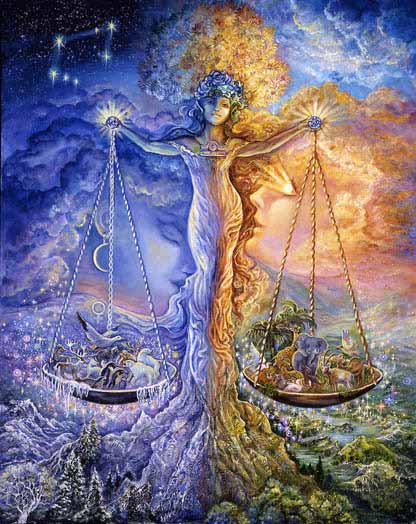
As a Libra woman, Justice is an ideal that is deeply embedded in my core values. I mean DEEPLY. Obnoxiously, sometimes.

Wait. I should back up and start from the beginning, perhaps. Why would Justice matter so much to a Libra, you ask?

The constellations of the zodiac have not always been  set exactly as they are now. Space is expanding, and the stars are moving, which means that those lovely pictures have shifted a bit on us over the millenia. Libra is the only sign of the zodiac that is represented by an inanimate object -- the scales. Before we pictured those scales as independent, we saw them in the hands of the Virgin (Virgo), whose name is Astraea (or Asteria -- the Starry One).Yeah, I've written about Asteria before. She's quite important to me, too -- both as a Libran and as an Aphrodisian.

Asteria wields something else, as well -- the Sword (although as Virgo, this is always identified as an ear of corn). She is the Lady Justice.

The Theoi.com entry on Astraea reveals that the Ancients regarded her as the daughter of Aphrodite, which makes good and logical sense, given Aphrodite's stellar associations. It also makes good and logical sense when we consider that Libra in "ruled by" the planet Venus and is therefore under Aphrodisian influences such as a deep need for beauty, grace, harmony and romance. Librans also sincerely require Justice -- at least, this one does.

My nose gets seriously off-kilter when I sense unfairness, even when it's in my favor. I might like to be pampered -- and I do -- but I can't abide that special treatment coming at someone else's expense. My need for equality and Justice is deep-rooted, and as it turns out, it is an Aphrodisian value.

Tuesday, May 8, 2012

I- Initiation #paganblogproject

Initiation takes on so many forms in the world of modern Witchcraft, and it has so very many roles to fill. What form and function it takes depends largely on what you (or your coven/Trad) want, need, or expect from the initiation process.

Initiation as Graduation

It can be a marker of accomplishment in one's studies -- a validation and endorsement by a group. And I don't think that's an invalid thing for a person to want/need. We have ceremonies like that throughout our lives. Just because we don't ALL want it, doesn't make it wrong.

Initiation as a Mystery Tradition

Initiation can also also be an important immersion in a set of group mysteries and symbols that are difficult to transmit in other ways. This was the function of the Mystery Schools of the ancient world, and modern magical orders rely heavily on this system.

Initiation as a Test

It can and often is a series of trials to prove one's readiness to progress to a next level of study/work. In tribal cultures around the world, as well as in "modern" magical communities, initiations can be filled with a series of challenges -- ranging from physical to intellectual to emotional and even beyond -- in order to prove a candidate's worthiness to move into the world of adults or to truly claim the title Witch.

Initiation is ALWAYS a Beginning

Whatever else it may be, though, initiation is a beginning. To initiate a process is to start it, and we are starting a cycle when we enter the circle of initiation. We are starting a process within ourselves that has great weight and meaning. I think each Initiate's experience varies, because their reasons for beginning the next step are so different.Their processes and cycles have been different, but the commonalities along the road are part of what bonds Initiates to each other. "I've been where you are." or "We faced that trial together."


Star & Torch Society -- A Witchcraft Circle of Initiations

I had the idea a few months ago to establish an Initiatory System for solitary Witches who felt the "void" of not being able to experience the Mysteries of initiations at the hands of experienced Priests and Priestesses. There is more to coven work than just claiming initiations, for certain, but hear me out.

The OTO (Ordo Templi Orientis), of which my very witchy wifey and I are members, allows every free man and woman the opportunity to take certain initiations. There are 10 degrees in the OTO, and anyone is welcome to take the first 4. So, okay, ... what if we were to form an Eclectic Initiatory Circle?

Most versions of Craft have 3 degrees.We thought to adapt the same model for this Society:
1* -- Witch and Initiate
2* -- Simple Priest/ess
3* -- HP/S

Furthermore, each of the initiations draws on a cycle of myth, symbol, and traditional initiatory experience.

Initiators are trained to deliver the same initiations to everyone, working from the same ritual script.

This isn't just for the collection of degrees, though I suppose some will use it for that. (Some always do.) I'm really thinking of something in which the Initiations are self-contained experiences -- rich in symbolism and Mystery, lots of meaning to be discerned by the Initiate both during and after. With periods of time in between,  for people to continue their studies and grow.

Nothing can replace the initiations at the hands of the Gods, and coven initiations can't force those experiences to happen no matter how much a person has studied. What we want to offer is a Mystery experience of value and deep meaning to the folks who are otherwise unable to study with a group.

This will not be a teaching group. Witches are expected to study on their own, just as Magicians do within the OTO or other similar groups. Get a good basic understanding of the Craft. Pursue the interests that call to you. Do your Will. Prepare yourself for initiation by immersing yourself in your magic. What and how you study between your initiations is entirely up to you. To that end, the initiations are NOT "certificates of completion" of a course of study, the way they can be in some Craft traditions. They would be a system unto themselves, giving Initiates a place of common Gnosis, common Mystai -- and the opportunity to truly experience the revelatory cycle of death and rebirth that is at the heart of all initiatory systems. (It's one thing to know it academically, it's another to have undergone it.)

Let it be clear, as well, that I have no intention of ripping off the OTO. I mention them here because, as a means of initiating people into the Mysteries, and then giving them the freedom to study what most appeals to them, the OTO has a great system. It's very much what I have in mind here, except that we wouldn't be using the symbols and Mysteries of that Order, we'd be using the symbols and Mysteries of Witchcraft.


I - Incense Secrets #paganblogproject

I was very fortunate to learn some techniques for incense blending from my former HPS -- and I picked up a lot of my own tricks over the years -- tricks I'm going to pass on to you!

Okay, so basically you can burn just about any botanical and call it incense, and you would be 100% right. Simple incenses are most frequently resins, blossoms, leaves, woods, etc that are dry enough to burn and have either a pleasant aroma or an effect on the etheric body.

Blended incenses, though, rely on the interplay between components, and the each plant brings its particular attributes to the mix -- not just in a magical sense, but in mundane physical one as well. For instance, dried leaves burn really fast, while woods and resins smolder longer.

I was taught that the most advantageous incense blends consist of a CORE of 5 ingredients. You can use more than 5 in a blend, but start with the 5 basics for a good mix. You can remember these 5 through the acronym FLOWR.

F -- flower/blossom (This can also be dried fruit or berries. You're trying to get to that blossoming part of the plant.)
L -- leaf
O -- oil (Can be an essential oil, base oil, conditioning oil, etc)
W -- wood (Can be the bark or pith. Can also be a root or nut.)
R -- resin

I use a few ingredients, on occasion, that don't fit anywhere on this list, of course. But I always start with my 5 Basics. Other things I might include are a pinch of salt, a little forge scale (the black stuff that flakes off while you forge metal), hair/nails, blood or blood substitutes (like egg, pomegranate juice, etc), ground gemstones. You get the idea. Anything is fair game after the 5 Basics.

Does it always smell pretty to burn, say, sulfur and hair? Heck no! But when that's what the magic calls for, that's what I include. Plus, I make sure to ventilate with things that are stinky, toxic or overwhelmingly smoky.

Magic is often messy, and it is sometimes rank and rancorous. Of course, sometimes it smells and tastes delightful.

Now, *I* think it's fairly obvious that you want all of the part of your incense working toward the same magical goal, but maybe it's still worth repeating. If you've included an ingredient, it shouldn't ONLY be because you needed, say, a wood. That wood should support the work you're doing.

There are a few books that I used as invaluable resources when I was first learning this Art:

Cunningham, Scott. Encyclopedia of Magical Herbs.
Cunningham, Scott. Complete Book of Incenses, Oils, and Brews.
Hopman, Ellen Evert. A Druid's Herbal.


Friday, April 20, 2012

H - Helen of Sparta/Troy #paganblogproject

Part of my personal Aphrodisian gnosis is that Helen of Sparta (later of Troy) is one of the avatars and "priestesses" of Aphrodite that we see in Greek myth. She shares a great number of identifying characteristics with the Goddesses of Love and Beauty, including being named Dios Thugater, Daughter of God (Zeus). Aphrodite, a patroness of the Trojans, gives this daughter of the Hellenes -- wife of a Hellenic king --  as a prize to Paris without so much as a thought to whether or not she was hers to give. Even among the immortals, this is bold unless we consider that Aphrodite does indeed have a claim on Helen.

And she does. Helen's ancestry is attached to Aphrodite for generations, putting the girl squarely in the Golden One's hands. When Aphrodite says "Go" (as she tells Helen several times throughout the mortal's relationship with Paris), Helen is compelled to obey.

One of my current writing projects is a novel (Temple of Beauty) that explores the life of Helen, much as my book Temple of Love explored the life of Sappho. What follows in this blog post are excerpts, two full (non-consecutive) chapters, from the Temple of Beauty, my own interpretation of the life of Helen of Sparta. (It is told in the voice of her sister, Clytemnaestra.)

*~*~*~*~*~*

“Entwined”

“My mother did NOT have sex with a swan,” I raged as a child. “God or not! Who would do that?”

Nobody listened to me, though. “You were hatched from eggs,” they said. “Zeus came to your mother as a swan, knowing she would never knowingly betray her husband.” They pointed to my brothers’ skullcap hats as proof. “The remnants of the shell,” they whispered. Secretly, I believe our brothers wore the hats because of people’s silly rumors. They found it to be a great joke when we were young, and as adults it always worked in their favor to remind the world that they were “sons of Zeus” – men worthy of consideration.

Helen and I are twins. You might have known this, I suppose, but it’s easy to forget since we look nothing alike. Everyone knows our brothers are twins. Kastor and Pollux. Living their lives so bound up in each other, the gods transformed their twin souls into star-set Gemini when they died.

No stories of sisterly affection or close bond for Helen and Klytemnaestra, though.  We didn’t begin or end our lives with enmity, but where our brothers lived and died by each other’s sides, Helen and I were as alien as any two women could have been.

Our mother was the Queen of Sparta, just as Helen was after her. She bore the four of us together, but two of us were sired by the mortal king, while the other two were fathered by an immortal god. Helen and Pollux had the touch of divinity upon them from birth. Beautiful, radiant, marked.

“Zeus, king of the gods, is the father of those two,” people said. “He placed the starry swan in the sky to mark the birth of beautiful Helen.”

The boys were both strong, swift and clever. They wrestled without fear, laughed without shame, and rode without division between themselves and their mounts. Sparta hailed them as the kingdom’s young defenders, and they first practiced this role on Helen and me.

We girls also wrestled bravely, as all Spartan women must, but Helen’s skill in the arena was not enough to prevent her first abduction or to manage an escape. Only Kastor and Pollux could reclaim her from Theseus. Only Kastor and Pollux could smuggle Helen out of Athens and restore her to Sparta.

Theseus stole Helen from us when we were fourteen. Theseus, victor over the Minotaur. Theseus, ruler of Athens. Theseus, lover of every great beauty in the Mediterranean. And so the great hero decided he would have my sister and could not be persuaded otherwise, not by my parents or by the gods themselves.

“Athens is the greatest city in Greece, fair Helen,” he said to her as his oarsmen swiftly rowed them toward that place and away from my father. “Being king there, it is fitting that my queen be the daughter of immortal Zeus, king of the gods. His favor, through you, will shine on me and my city.”

The Spartan princess gave him nothing easily, not even words. What he had from her, he was obliged to take.
“You are my bride now, beautiful Helen, child of Zeus,” he cooed in an attempt to woo her. “That means that you are Queen – and wife to the greatest hero of our age.”

An ugly look crossed her pretty face as she sniffed in disdain.

Nonplussed, he sputtered, “Am I not worthy of the daughter of a God?” His rage was rising.

Slowly, her glinting eyes glided back to his gaze. “I would be the happiest wife of the lowliest hoplite in Sparta if I could rid myself of your arrogant Athenian imposition.”

His only retort came from the back of his hand, and it left the side of her face swollen, stinging and red. She silently vowed never to give him the holy saltwater of her tears, not for so small an injury, and certainly never when he might see her.

She lived as his prisoner, if also as his wife, for two years. Her mother-in-law became her warden, and the daughter she bore to Theseus became her tiny cell-mate.

Of course, Helen would have been known to the world as “Helen of Athens” if it weren’t for our brothers. The boyhood games of rescuing Helen and I from sea monsters as we cursed and fought against the imagined creatures from our restraints on the rocky shore transformed into the battle tactics of men. Young men, brash and bold and un-bearded, unwilling to have a sister and a woman of the royal house of Sparta snatched from under their noses.

“A small crew is best,” Kastor told our father. “We want to be unseen, slipping through the waters, through the city, through Theseus’ door.” Kastor was always such a cunning youth. His wit sliced like a knife. You wanted him with you for every sticky situation, knowing he would carve a way out of it.

They waited, watched and listened within the walls of Theseus’ lands when they arrived. Using plots and ploys, they let the hour ripen to pluck Helen from her jail, stealing away her warden to become her slave as revenge for their sister’s abduction.  When Theseus went to the underworld to abduct a bride for his brother, Kastor and Pollux brought Theseus’ own mother back in servitude to Sparta, Helen’s servant for many years.

“And on his throne, we left his rival to rule,” Pollux crowed, drinking the sweet wine for which he was named.  “Theseus is brought low for his pride. He sought to steal the daughters of the gods from the families to whom they belong, and he has lost all.”

 “He took me,“ Helen told me later. “He took me from my home and family. He took me from myself, my maidenhood. Gave me his daughter to bear and his mother to watch over us both. He thrust them both upon me, and then he left us all as he went in search of greater glory and an immortal wife for his brother. Theseus.”  She spat on the earthen floor when she said his name. Such crudeness from my pristine twin.

She was utterly unable to love the child. “She looks like her father,” she said plaintively as she looked into the little girl’s face. “All I see is him when I behold her. How can I take her lovingly to my bosom when she reminds me of the man I despise? Perhaps I should seek a Spartan family to foster her. She is healthy.”

“She might be her father’s child,” I said, “but she is also yours. Iphigenia looks like our family, too, and she is touched with your beauty, Sister. I am, myself, roused with motherly affection for the little girl. Keep her within our own family, and give her to me to rear. I will be her mother, and you shall become her aunt.”

Helen was both elated and relieved, but there was another emotion working behind that beautiful façade as well. An odd look came upon her as she placed the toddler in my arms. She studied our faces, and as moisture dampened her bright eyes, she said, “She looks like your own daughter, Klytemnaestra. ” She paused for a steadying breath. “And so she shall be.”

 So little Iphigenia became my daughter before I ever knew the marriage bed.

Kastor and Pollux made sacrifices to Zeus, king of the gods and father to the divine ones among us. Helen made sacrifices to Aphrodite, goddess of love, thanking her for being rid of an unwanted union.  I now had a baby, no husband and no stain upon my honor for the unlikely combination, so my sacrifices were for Artemis, the protectress of children, of girls.

Both sets of twins were reunited –  sisters and brothers, divine and mortal, connected  and separate. Our tales are linked together, the four of us, from our births to our deaths. Kastor and Pollux were bound up in each other so that the world saw it at their first breaths, but none of us were ever free of the bonds of kinship, of twin-ship, that ruled our lives. They would set sail again to reclaim Helen for Sparta, for abduction was a cycle stamped into her very soul.

 I would stay behind. Our childhood games never positioned me to rescue my sister, and reality didn’t have us both ravished and in need of rescue. Indeed, I was a prudent and unsung foil to my impetuous and fabled sister.

 “You are my mirror’s reflection,” she said to me once. “Or perhaps I am yours. It’s hard to tell which side of the polished copper I stand on when I look at you. I see myself as I ought to be  – the dutiful mother, the honorable wife, the mighty queen.”

     I would forever be her reflection, and she would be mine – opposites, staring at each other from across a thin but impassable gulf.


“Abduction”

She loved Menelaus like no other. History and myth haven’t told that portion of my sister’s story well. For Helen, the Spartan queen, her strong war-king was a far greater prize than a pretty shepherd. Paris was her duty, as the golden Goddess of love made clear, and Helen loved him as much as her body would allow. Her spirit, though, had been wedded to the towering, thundering, iron-hardened warrior who swept across the sea to reclaim his beloved queen.

If she was Aphrodite made flesh, he was Ares. They were mortal enough to die in the end, I promise you that much. For proof, look to the banks of the river near the town of Therapne. My sister’s clay was burned there, high on the funeral pyre. A tree still stands there in her honor, and a shrine they call the Menalaion, for her husband.

I won’t lie to you, gentle guest, and say she didn’t love the pretty shepherd, too. Paris was charming, and he endeared himself to Helen of Sparta. The Gods make their plans, and Aphrodite always knew that Helen would make the journey across the sea to Troy. Even before that dreadful contest.

You’ve heard the tale of that golden apple and the appointment of Paris as judge, I’m sure. No? Oh, my friend, the world believes the story starts here, so let me share the briefest telling of that tale.

At a certain marriage feast, all the Gods of Olympos were invited. All but Eris, for who would willingly welcome Strife into their marriage? And yet, who could keep her out? And so she came, but the gift she brought was conflict, cleverly concealed. She rolled in a golden apple engraved with a single word. “Kallisti.” It means “for the fairest.” Aphrodite, with the grace of a dove, bent to lift it, knowing she was the fairest of gods and men. Hera, queen of the Olympians, recognized the apple as being stolen from her own evening orchard and strutted with a peacock’s beauty to claim the prize, while grey-eyed Athene, stunning in her wisdom, swooped in to forestall the fray. When the parents of swift Akhilles married, all the Gods of Olympos were invited. All but Strife, for who would willingly welcome Strife into their marriage? And yet, who could keep her out? And so she came, with a gift of her own. She rolled in a golden apple engraved with a single word. “Kallisti.” For the fairest. Aphrodite, with the grace of a dove, bent to lift it, knowing it was hers. Hera, queen of the Olympians, recognized the apple from her evening orchard and strutted with a peacock’s beauty to claim the prize, while grey-eyed Athene, stunning in her wisdom, swooped in to forestall the fray.

Paris was chosen to settle the dispute that erupted between the three goddesses. Paris, a Trojan prince. Paris, a handsome and romantic youth. Paris, a shepherd whose city was favored of old by lovely Aphrodite.

Each goddess appealed to the young prince with the greatest reward she could offer the young man. Hera, in all her royal authority, came to him first. “I can make you a king like there has never been among men before. Your father is a majestic man, but your reign, young prince, will span boundaries no mortal has yet dared to reach and bring you riches beyond imagining. Kingship will be yours, if you give the apple to me.” She left him with a light in his eyes and a desire for power he hadn’t known could stir within his heart.

Happily considering her offer, Paris was approached by solemn Athena. He saw the warning in her eyes, like storm clouds building over a troubled sea. “That apple is no trifle or trinket, Paris. By giving it into my care, you would show wisdom beyond other men. I can turn that wisdom into the makings of legend and lore. Your name will be sung for generations beyond count as a great hero.”

Aphrodite spoke directly to the shepherd’s heart. “The apple’s intended owner is clear enough, sweet boy. It is marked ‘for the fairest,’ and that is me.” She blushed sweetly and continued, “Is it a boast if I say this of myself?”
Paris, at last given leave to speak among the immortal ones, said, “It is not a boast, for all the poets and philosophers hail the beauty of golden Aphrodite.”

“There is a mortal woman whose beauty the poets sing, too, sweet Paris,” Aphrodite continued. “Helen of Sparta is a woman in whose face and form my own beauty shines. In exchange for this prize, lovely Paris, I will give you the greatest love the world has ever known. You will be beloved of the most beautiful woman in the world, and poets and philosophers will tell your tale until the gods turn their shining faces from the world and men have sung their last songs.”

And so, my friend, Love won the contest. Oh, the war was bitter and Helen was cursed by Trojans and Greeks alike, but Aphrodite knew that Paris was like most mortals. He understood that love was as precious as gold.

H - HPS Disease #paganblogproject

I'd like to write about a very serious matter that affects an unfortunate number of Witches and Wiccans, possibly even with some over-spill into the greater Pagan community. This is a condition that I have not only witnessed first-hand, but it is one that I have had to battle myself. I'm glad to say that I came back from my exposure to this illness -- for it is truly an affliction -- though my rebound was not through any great enlightenment, strength, or power of my own. I was lucky enough to have it knocked out of me, which is (I believe) the only real way to recover from it.

I'm speaking, of course, of High Priestess Disease.

HPS Disease can affect either gender, but it is most commonly seen in the female -- the Priestess -- since it is She who is given Supreme Authority within most Wiccan Traditions. Even outside of Wiccan Trads, the custom has been adopted by many that the HPS outranks the High Priest (HP) should they come into conflict.

Oh, and how many times was such a phrase uttered: "So sayeth I -- Lady Goldenhair, Lady Fuzzy-Butt, and SHE!" Thus endeth all debate from amongst the lowly plebeians.


A Witch with HPS does not understand the workings of an egalitarian, non-hierarchical coven. In fact, a well-meaning mentor with a clear case of HPS warned me against "giving away my power" when I shared responsibility and duties for coven tasks with my coven-mates.

Very serious cases of HPS Disease can be noted in which Witches refer to themselves in public, social settings as "Lady" Such-and-Such -- often as part of their e-mail signature/name or online alias. They often anticipate that others -- people completely outside of their own covens -- will refer to them as Lady Daphne or Lady Velma without batting an eye. (If this *doesn't* strike you as odd, the custom of referring to a 3* priest/ess as Lord or Lady originated as part of circle etiquette -- reserved for circle, and used with magical names known within the coven.)

I started to fall into the trap. I'll admit it. I followed a bad example a little closer than I realized and started taking the "because I said so" attitude with my covenmates. I lost one because of it -- lost her as a friend, which still pains me. My coven and the whole darn Trad fell apart because my own HPS had such a serious case of it that first she and I fell out, and then she broke up everything.

Power over others is not a power that I think plays out well in modern Craft -- not even in modern versions of Traditional Craft (like I practice). I am again the Mistress of a coven -- one of two Mistresses. We are its care-takers and protectors. Its mentors and teachers. And as each Witch is raised up in the Trad, they come to see that they are just as responsible, just as powerful (and sometimes as powerless) as we. Each teaches and each learns. The only difference is in the length of time on the Path, the number of times around the Mill.